5×4 Matrix{Card}:
 T♣  T♢  T♡  T♠
 J♣  J♢  J♡  J♠
 Q♣  Q♢  Q♡  Q♠
 K♣  K♢  K♡  K♠
A♣ A♢ A♡ A♠Introduction
If there’s one hand in Texas Hold-Em’ that you’re likely to shove all in on, it’s probably one that looks like this:

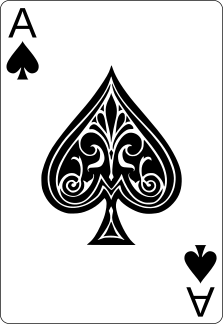
As we showed in a previous post, Pocket Aces have good odds of winning the hand–even in a multi-person pot.

When a player has this hand, it’s expected that they will play it aggressively. However, when playing online–and potentially when playing in-person–every so often you will encounter a player we’ll call a “maniac.” This player seems to raise every hand they get pre-flop to a ridiculous amount, let’s say 15x the big blind, even though we can surmise that they’re playing this way with any-two-cards (ATC) and not exclusively playing their premium hands.
This type of player can feel exceptionally frustrating to deal with to a newbie, especially when someone eventually challenges them with AA and loses to 3-of-a-kind twos or a similar bad-beat. And of course, when you lose you start to tilt.
I’ve encountered this type of player multiple times, and despite my efforts to the contrary…they do tend to frustrate me. But there is a winning strategy against this kind of player, and though it may feel boring it can pay off quite lucratively.
Playing Against a Maniac
Just…Fold
There is always the temptation in Poker to play more hands, mostly out of boredom or occaisonally from folding what turns out to be the nuts. Of course, if you are the Big Blind (BB) (or even the Small Blind (SB)) and everyone checks/folds over to you, I don’t see anything wrong with going ahead with non-premium hands, small pocket pairs, low to mid suited connectors, etc.
But remember, we’re talking about playing against a maniac. The cost of playing a shitty hand goes from just the BB/SB to a significantly higher amount. So, if you want to outlast this player, you’ll have to fold a lot more often.
More Specifically, Play a Tighter Range
The current Texas Hold-Em’ “meta” is to think in terms of ranges. To exploit the Maniac’s hyper-aggression, our simulation’s Hero employs a strategy of playing only the strongest, most dominant starting hands.
and the hands we’ll play will look like variations of these:
5-element Vector{Vector{Card}}:
 [A♣, Q♣]
 [J♣, J♢]
 [K♡, J♢]
 [J♡, J♢]
 [J♠, T♡]
This includes the pocket pairs like J♣J♢ as well as basically any broadway cards like K♡A♣.
For this post, I’m going to simulate outcomes in a simple way. The core assumptions of the simulation are as follows:
- heads up game, hero vs. maniac
- fixed blinds, Small Blind ($50) and Big Blind ($100)
- the “button” (which determines who posts the small/big blind and acts last on later streets) alternates every hand.
- the simulation starts with both players having $100,000, which is 1,000 Big Blinds
- except for one specific pre-flop case for the Hero, the players cannot fold. Once a player starts the hand, they are forced to call all subsequent bets or go all-in.
Caution
This is a very simple simulation I did just for fun, we’re not trying to go game-theory-optimal here…just proving out an idea with a toy model. In real poker, the complexity increases significantly as players can adapt, bluff, and use variable bet sizing.
In real life, the maniac would likely adjust their strategy after losing. But if they stuck to their ATC strategy, over the long run it is a massive leak.
The Hero’s strategy is quite simple: play a tight range, if the hole cards dealt are not in the range we described before, they immediately fold and lose their commmitted blind. But if the hand they’re dealt is within aforementioned range, they will call the maniac’s bets every time.
The maniac in our simulation also has a very simple strategy: they always post the required blind, and subsequently bet a large, fixed amount (15x the BB) on the flop, turn, and river. Their hand is irrelevant, and they will bet this amount regardless of whether they have a strong or weak hand.
Here’s the results of a simulation of multiple hands:
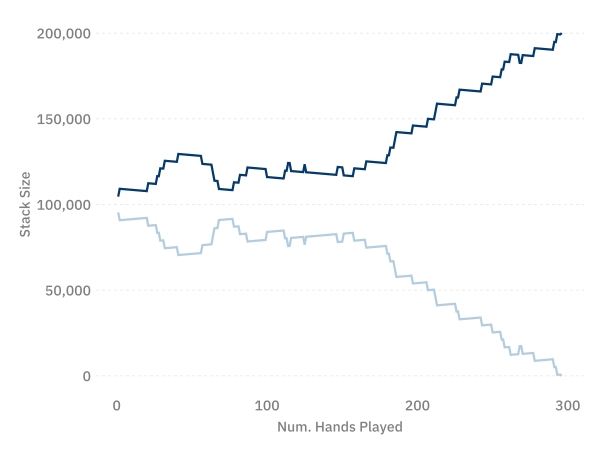
While there are cases where the maniac wins in the short term, they eventually go broke around 300 hands.
There is always some variation in Poker, and using different random seeds to change the draws from the deck we can see how this strategy plays out in different scenarios.
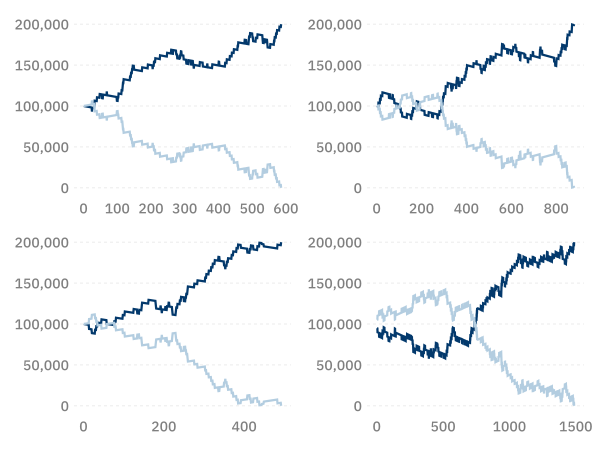
While the length of time it takes to bust out the maniac varies, the result is the same over time. Even in the 4th scenario, where the maniac is ahead in stack size for a while, their strategy eventually fails.
How to Apply this IRL
As I mentioned before, this is a very limited simulation to demonstrate that ATC play against a tight range is not profitable in the long-run.
Confirm Maniac Status
Before implementing the simulation’s strategy, you must confirm your opponent is truly playing any two cards. A real maniac won’t just raise pre-flop; they will frequently continuation bet with garbage on the flop and barrel subsequent streets without thought. Look for them showing down terrible hands after aggressive betting, as that is a green light to tighten up and start exploiting their play.
Slightly Broaden Your Range
The simulation uses a tight range. In real life, playing this tightly means you lose too much money to the blinds over time. Against a confirmed maniac, you can expand your range to include things like A5s-A9s and all suited connectors above 76s. This lets you maintain an equity advantage over their random hands and avoid folding away all the blinds.
Be Aggressive When it Makes Sense
In our simulation, the Hero simply calls the Maniac’s 15x bet. In real life, and with true monster hands, aggression is the name of the game. For example, if you have K♠K♡ or something similar, then you should make your ATC opponent pay up to see the flop assuming they will play with trash like 7♠2♡. If you hit top pair or better on the flop, don’t just call…raise their bets.